Garden of Choices
Resources for Argument Analysis
Argument Analysis
When analysing argument, identify the persuasive techniques used in a text in relation to the author ‘s contention.
Consider the language components below and examine how I use them in Garden of Choices to influence my audience. These are the devices you learn to identify, explore and use in argument analysis.
Contention
Usually, a writer’s main argument (the contention) is immediately stated. Especially in opinion pieces and speeches, which are commonly explored in this unit of study, the contention is either in the title or in the first paragraph. However, an unreliable narrator like me can draw out the real argument. I use positive phrases - ‘she winked’, ‘responding to his frown lines’ - to throw you off Apple’s true intention, and make you work to find my contention: Don’t fall for the devil’s sneaky temptations.
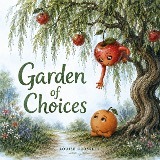
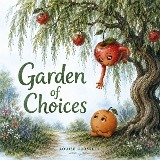
Refer to an opinion piece or speech (I will call this 'your text' moving forward). Examine the first paragraph. What does the writer want you to believe? This is the contention. Compare the texts. This title. This front cover. Do they hint at my contention? Now examine the title of your text. What is it hinting?
Arguments
I foreshadow several points to support my contention which is only crystal clear after the whole story has been told. The very last page reveals that Apple is unquestionably rotten. This is exposed using the allegorical theme of the Garden of Eden. In the same way the snake tempts Eve with the apple in Genesis, Apple herself tempts Orange in this story.
Once this is clear, the arguments are too:
1.The majority is not always right: Most of the Fruit in the Garden have taken a bite of Apple. Orange is a minority.
2.Nice gestures sometimes hide bad intentions: Apple seemingly supports Orange with his sick mum but it’s just a ploy in an attempt to corrupt him.
3.The antagonist can be our mirror: Foreshadowed on page 9, where Orange sees his own reflection in Apple’s skin, his faults mirror her flaws. He identifies that Apple is showy, bossy and lacks discipline on page 19. Then he succumbs to the same faults on page 21-22: boasting, impelling and gluttonous eating.
Find these arguments in this book. Consider the words I use to create them. Now refer to your text. Annotate its key vocabulary and language devices to find the arguments.
Rhetorical Appeals: Modes of Persuasion:
Ethos (building credibility)
Initial trust is built through the characterisation of Apple. She appeals to the audience with her mischievousness, her confidence and her popularity. Even the book cover suggests that Apple is friendly. Seemingly wanting to share herself with Orange and never giving up on him, Apple is trusted to be cheeky with good intentions.
Locate the words/phrases/sentences that make Apple seem credible and nice. Now find language that builds credibility in your text.
When the unreliable narrator is exposed, clues are remembered, and my credibility is secured. I foreshadow the apple of temptation in the front cover and then confirm it on the last page with the Garden of Eden. I foreshadow Apple's plan to allure Orange into tasting her in the beginning of the story and confirm it near the end with the banquet made of apples. These work to further persuade my audience, because even though I trick you in believing that 'she’s no rotten Apple', I never lie.
Pathos (emotional persuasion)
By embedding the 9 Fruits of the Spirit (love, joy, peace, patience, kindness, goodness, faithfulness, gentleness, self-control) into the story, I influence the audience to refer to biblical foundations. It helps readers feel the effects of these Fruits from the perspective of Orange and his mum.
Find the 9 Fruit of the Spirit in this text (many not directly but inferentially included) and respond to how they position you, the audience. What do they make you feel, think or want to do? How do they build my characters? How do they move the story? Now find examples of pathos in your text.
Verbs like ‘help’ and ‘suffer’ are used as a ploy, warning audience to beware of dramatic responses.
The play with the word 'humanity' to 'fruitanity' uses the suffix 'an' + 'ity', together, meaning 'the condition of being'. Here, the unreliable narrator presents Orange as not existing in the same way that the other fruits do. Making him the other/outsider.
Find examples of strong language in your text. How do they persuade you? Are they genuine or a ploy? Why do you think so? Are there play with words in your text? If so, look up the meaning of the prefix/suffix that help create these word play.
Logos (reasoning)
Apple uses reasoning to persuade Orange to let her help him, "My talents and my many friends can be of service." Mum uses reasoning to put thoughts into perspective, "It’s not our job to judge them, but to ponder situations before making our choices.”
When the readers compare these approaches, it becomes clear that Apple’s reasoning is centred on vanity while mum’s is centred on good values. These parallels highlight intention, hinting at Apple's true nature.
Consider how reasoning is used in your text. Compare the parallels of reasoning. How does the writer build a logical argument? How else do they reason with you?
Antanaclasis
I use this figure of rhetoric in the phrase, ‘…ensuring you eat well to get well’ (p.22). Using the same word twice in one sentence to form two meanings is antanaclasis. Repeating the homonym ‘well’ to mean first ‘good’ and then ‘healthy’ brings attention to Orange’s moment of hypocrisy. As an unreliable narrator, I give the protagonist the same flaw as the antagonist to make you question his integrity.
Appeals
Apple uses several appeals to mislead Orange. Eventually, this works to reveal her own true nature and persuade the audience to look beyond her friendly exterior.
Appeal to patriotism: using Orange’s love for his culture to manipulate him: ‘You give the Citrus culture a bad name’.
Appeal to guilt: using Orange’s love for his mum to convince him to let her in: ‘Don’t you want your mum to receive good care? Trying to do it all alone will only extend her suffering’.
Appeal to fear: using dramatic irony to show the audience what Orange cannot yet see (that he's being manipulated): ‘In this Garden of Choices, I will always be tempting’.
Use one of these appeals to write one supporting argument for a persuasive speech. Your contention is, 'to make good choices, you must be taught'.
Literary devices:
To sensationalise Apple's bad intentions, I use allegory. Specifically, I use aversive allegory (often used in dystopia), meaning to take the negative perspective as a warning to readers.
Consider how I use aversive allegory. What language or character actions suggest that Apple is not a role model at all but an example of manipulation? How do I get this across? Does it work to dissuade you from blindly following the majority?
Onomatopoeia is used as a false truth (page 17). Bringing attention to Apple’s support, onomatopoeia lists Apple’s efforts in the kitchen, but also, her effortful process of deception.
Refer to page 17 again. How do I use onomatopoeia to persuade you to be on team Apple?
Grammatical Moods:
Like the ho-hums of moody people, language too has its moods. There are four key moods in English grammar: imperative, interrogative, indicative and subjunctive. This is how they affect the mood of this story:
1.Imperative (bossy and commanding) e.g. ‘…let yourself taste me’.
2.Interrogative (suspicious and questioning) e.g. ‘You call yourself juicy?’
3.Indicative (informative and straightforward) e.g.’…people have many dimensions.’
4.Subjunctive (wishful and conditional) e.g. ‘If you had any sense at all, you’d let yourself taste me’.
Find one example of each of these moods in your text. How do these sentences effect the tone of the text?
Grammaticality:
In this picture book, partitives (small parts of a whole) are used to show the many small ways in which wrongs can be disguised, making them seeming 'inconsequential'. The list of these words (page 23) infer warning to the audience: beware of small wrongs that hide and grow.
Read page 23 again. How do these partitives persuade you to 'review situations before making...choices?
Fallacies
Apple uses these false truths to corrupt Orange:
Bandwagon: Points out that most fruit agree with her in an attempt to use peer pressure to have Orange join them: ‘Everyone else said yes’.
Ad Hominem: Attacks Orange personally to shame him into changing his mind: ‘You call yourself juicy? You’re supposed to be bright!’
Write an additional supporting argument for your text using one of these fallacies.
Call to Action
My indeterminate ending (intentionally unresolved) leaves Orange's fate unclear. I deliberately keep him torn between his mum's good advice and his fascination with Apple to highlight the devil's sneaky temptations. Through Orange’s moral dilemma, I call you to consider intention before being influenced by others. I call you to pay attention to small thoughts and small decisions that contribute to big mistakes and don't succumb to peer pressure. And most of all, I call you to listen to that ‘voice in (your) heart’; It’s God talking.
Read the last paragraph of your text and identify what the creator wants you, the audience, to do, think or feel - what's the call to action?
Using the persuasive devices discussed here, write your own persuasive story using the Garden of Choices as a mentor text. Then write a persuasive speech on this topic: Listen to that voice in your heart.
Home-Books-About-Contact
Visit Louise:
louisecrossley.com
Twitter:@crossley2010
(C) 2026 louisecrossley